The short version: ductless wins for most older homes
For Seattle homes built before the mid-1980s without modern ductwork, ductless mini-splits are usually the right answer. You avoid the cost of running entirely new ductwork, you get zone-by-zone control, and the install is far quicker and less disruptive.
Central AC still wins in a few cases: homes that already have functional ductwork from a forced-air furnace, larger homes where you would need a lot of indoor units, and homes where the homeowner does not want visible wall-mounted units.
Why ductwork is the deciding factor
Most older Seattle homes fall into one of three heating setups:
Radiant or boiler heat, with no ducts. Many old craftsman and mid-century homes use radiators or in-floor heat. There is no ductwork at all, so adding central AC means installing a complete duct system from scratch, which is expensive and means opening walls, ceilings, and floors.
A forced-air system with undersized or leaky ducts. Common in mid-century homes. The ducts exist but were not sized for the higher airflow modern AC needs. Sometimes we can work with them with modifications; often we cannot.
Wall or floor furnaces, with no ductwork. Older homes sometimes have these, and there is nothing to tie central AC into.
In every one of these, ductless mini-splits skip the ductwork problem entirely. Each indoor unit serves a room or zone, so no ducts are required.
The cost comparison, in plain terms
The biggest single cost driver between the two options is ductwork. When a home has no usable ducts, adding central AC means paying for a full duct installation on top of the equipment, plus the drywall repair that comes with it. Ductless avoids all of that. That is why, for an older home without good ducts, ductless usually comes out meaningfully less expensive and far less disruptive.
When a home already has functional, well-sized ductwork, the math flips, and central AC can be the more cost-effective choice because the expensive part is already in place.
We assess your ductwork during the consult and quote both options where both are realistic, so you see the real numbers for your home.
The comfort difference
This is the part most people do not think about until after the install.
Central AC cools the whole home to one thermostat setting. Some rooms run cooler and some warmer depending on where they are in the duct runs, and older homes tend to make that unevenness worse.
Ductless multi-zone cools each zone to its own setting. The bedroom cool for sleeping, the kitchen warmer because it is empty during the day, the living room comfortable when occupied and off when empty. Each zone has its own control. Because you only run the zones you are using, this approach often uses less energy than cooling the whole house to one setpoint.
When central AC wins for older homes
A few scenarios:
You already have functional ductwork. If you have a relatively recent gas furnace with good ducts, adding central AC is straightforward and cost-effective.
Larger homes. Once you would need a lot of indoor units, the cost of ductless stacks up and central AC can pull ahead.
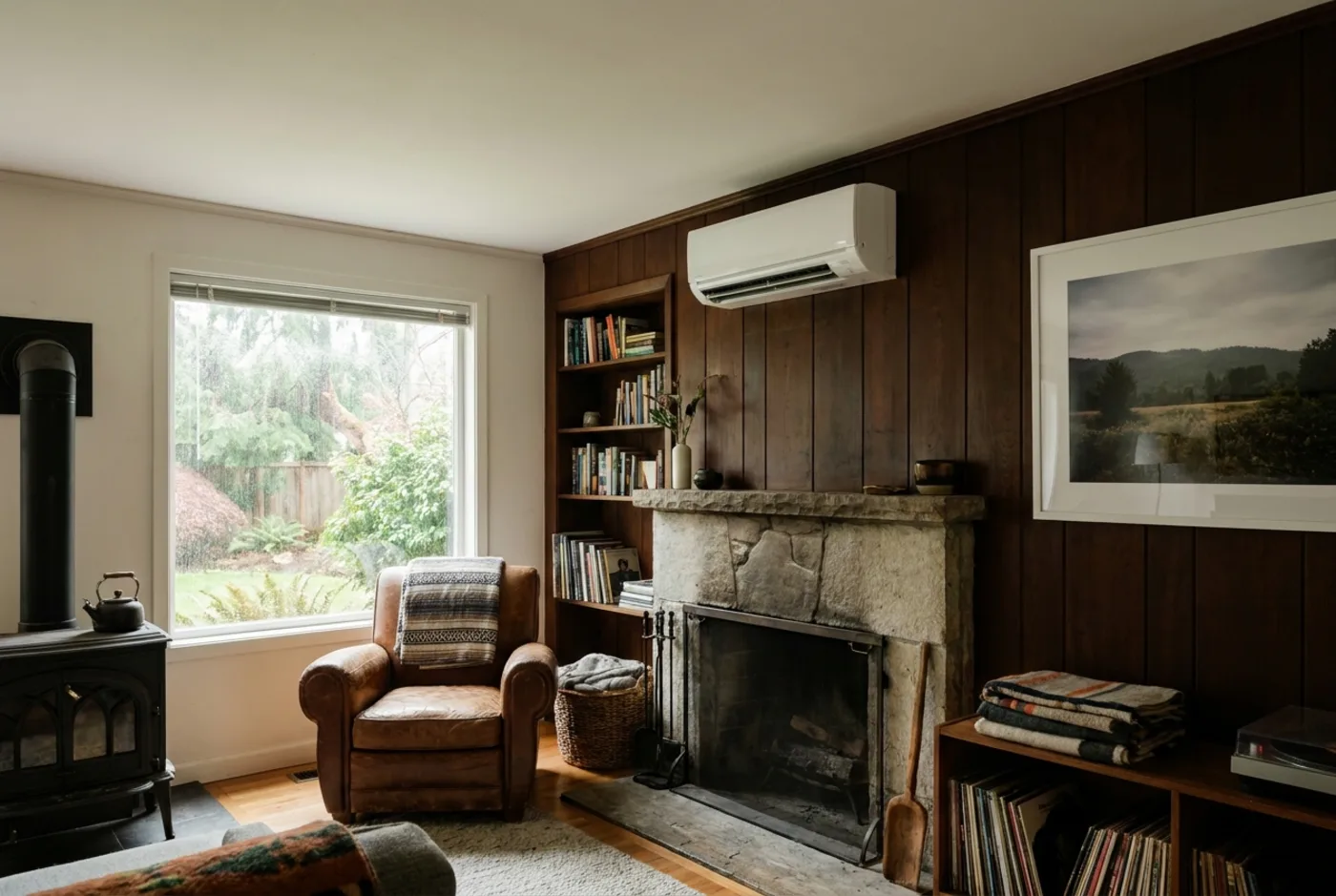
Aesthetic concerns. Ductless indoor units mount on walls or ceilings. Some homeowners do not want them visible. Concealed ducted mini-split options exist but cost more.
The heat pump alternative, often the best path
For older Seattle homes considering cooling, the best path is frequently a heat pump rather than dedicated AC. A ductless heat pump system heats AND cools, qualifies for the PSE rebate and the federal credit, and can replace an aging gas furnace, radiator system, or wall furnace. For a similar amount to dedicated cooling alone, you get a system that handles the whole year and lets you retire old heating equipment. That is why a lot of older-home cooling consults end up as heat pump installs.