
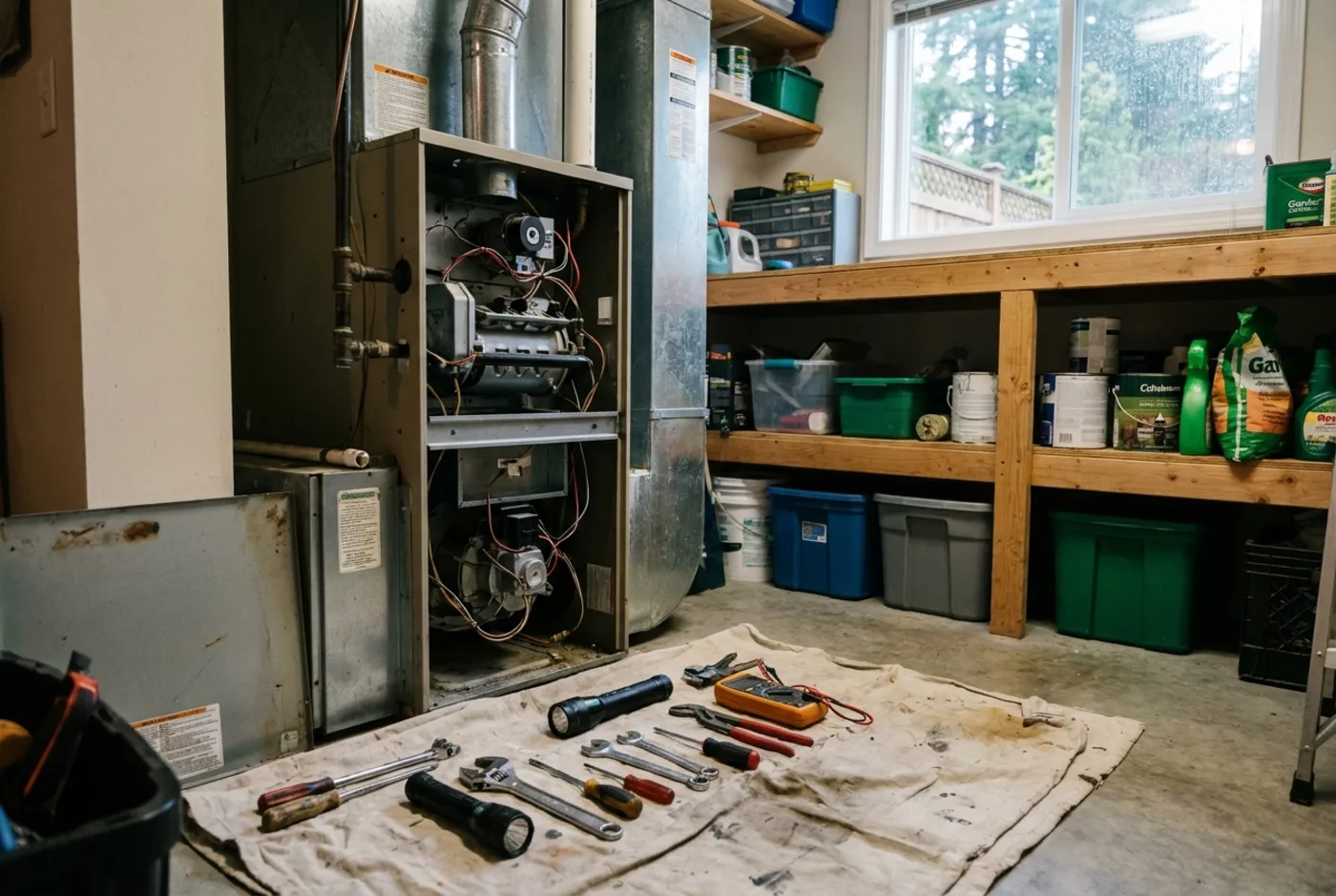
How our diagnostic works
Our diagnostic fee is $129 plus tax, and it is credited toward equipment replacement if you decide to move forward with us. A real furnace diagnostic takes time. A proper look means checking the burner, the sensors, the motors, the control board, and the safety components, not a quick glance and a sales pitch. The fee covers that time and a written diagnosis, so you know exactly what is happening with your furnace.
The common furnace failures we see
Most no-heat calls trace to a handful of parts. From the simplest to the most serious:
- Flame sensor. A metal rod that confirms the burner lit. When it gets dirty, the furnace shuts the gas off for safety. Often a clean restores it. This is one of the most common no-heat causes.
- Igniter. The part that lights the burner. It wears out over the years and eventually cracks.
- Capacitor. A small component that helps motors start. Inexpensive, common to fail.
- Blower motor. Moves the heated air through your home. A bigger repair, more common on older furnaces.
- Inducer motor and pressure switch. Part of the furnace’s combustion safety system.
- Control board. The furnace’s brain. On an older furnace, a failed board can signal the system is near the end of its life.
- Heat exchanger. The most serious. A cracked heat exchanger is a carbon monoxide safety issue, and on an older furnace usually points toward replacement rather than repair.
What drives the cost of a furnace repair
Three things mostly determine what a repair runs.
Which part failed. A flame sensor cleaning is at the low end. A heat exchanger or a full burner assembly is at the high end. The part itself, and how hard it is to reach, both matter.
Part availability. Common parts ride in our truck, so most repairs of that kind finish in a single visit. Less common parts (some model-specific control boards and premium motors) have to be ordered, which can add a few days.
Age and brand. Older furnaces sometimes need parts that are harder to source, which adds time. Some brands use proprietary parts that are pricier and slower to get than the broadly stocked brands.
The repair versus replace decision
A useful rule of thumb across the trade: if a repair is approaching half the cost of a replacement, replacing is usually the smarter money. On an older furnace, the threshold is even lower, because you are putting real money into an asset that has little life left.
The clearest cases for replacing rather than repairing:
- A cracked heat exchanger, which is both expensive and a safety issue.
- A major failure (or a stack of smaller ones) on a furnace that is already fifteen or more years old.
- A furnace that keeps needing repairs season after season.
The clearest cases for repairing:
- A single, contained failure (flame sensor, igniter, capacitor) on a furnace that is otherwise running well and is not near the end of its life.
For the full walkthrough, see our repair versus replace guide.
Schedule a diagnostic
Call (206) 200-9134. Our hours are Monday through Friday, 7 AM to 5 PM. The diagnostic is $129 plus tax, credited toward equipment replacement.