
The short version
A heat pump needs its own dedicated circuit. Whether your panel can accept that circuit depends on three things: your panel’s overall size, how much of it is already in use, and whether there is open physical space for a new breaker. Many newer Seattle homes with a modern panel need no upgrade at all. Many older homes with original, smaller service do. And there is now a third path, a smart load-management device, that can sometimes avoid an upgrade entirely.
The three things that matter
1. Panel size
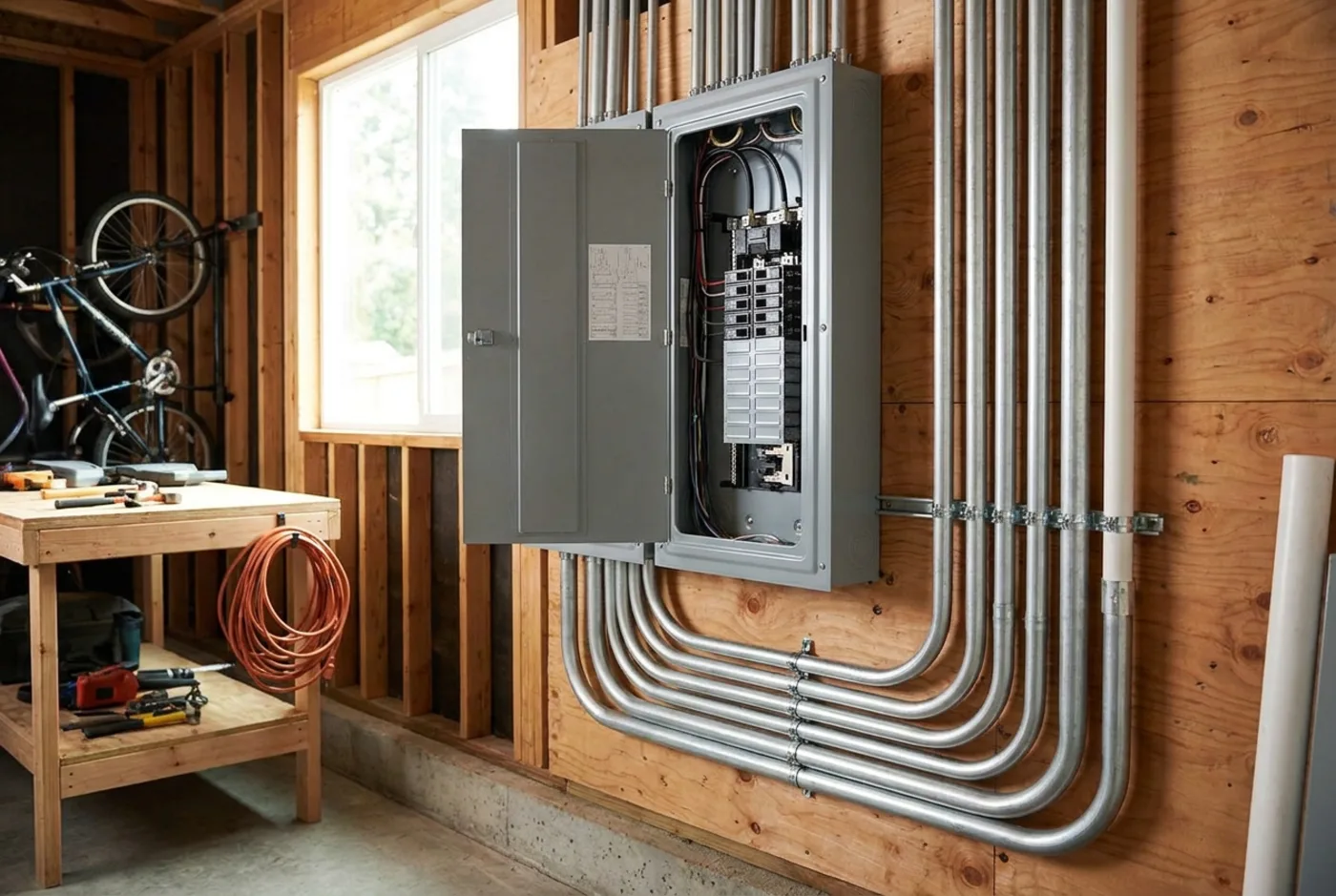
Look at the main breaker at the top of your panel. The number on it is your service size. Older homes often have smaller service that is undersized for modern electric loads. Most homes built since the mid-1980s have larger service that handles a heat pump comfortably. The smaller your service, the more likely an upgrade or a load-management device is part of the picture.
2. How much is already in use
Your panel’s rating is the total. What matters for adding a heat pump is the headroom, how much capacity is not already spoken for. A home with several large electric loads (electric range, electric dryer, electric water heater, an EV charger) has less headroom than a home that runs mostly on gas appliances. We look at what is already on your panel and what you plan to add.
3. Open breaker spaces
Even when there is electrical capacity, you need physical room for the new breaker. Some older panels are already full, with no open slots, even if the capacity is technically there. We open the panel during the consult and count. It is a quick, clear answer.
The three paths
Based on what we find, your home lands in one of three places.
Path 1: Modern panel, capacity and slots available
You are done. We add the new circuit, connect the heat pump, and no upgrade is needed. This describes a lot of newer Seattle, Bellevue, Redmond, and Kirkland homes, and most homes that have had electrical work done in the last fifteen years or so.
Path 2: A panel upgrade is the right answer
Your panel is either too small or too full, with no easy workaround. A panel upgrade is real work, but it comes with real upside:
- The federal energy-efficiency tax credit can include the panel work when it is required to enable the heat pump install.
- A larger panel future-proofs you for an EV charger, an electric water heater, or other electric upgrades down the road.
- It tends to add resale value in a way that simply patching the old panel does not.
This is the scenario most homeowners worry about. When it is genuinely needed, we explain why and put it in the quote up front.
Path 3: A smart load-management device
This is the option many homeowners do not know exists. A smart load-management device watches your panel’s total draw in real time and prevents two big loads from running at the exact same moment in a way that would overload your service. For example, if your home is already drawing heavily, it can briefly delay the heat pump compressor, throttle the EV charger, or pause the dryer for a few minutes. Modern heat pumps adapt fine to short pauses like that.
When it works well:
- Your panel has enough capacity for your typical load plus the heat pump, but you are concerned about the rare worst-case moment when everything runs at once.
- You are flexible about EV charging happening overnight.
- You do not have a lot of large electric appliances running continuously.
When it does not:
- Your service is genuinely too small, period.
- You have several large continuous electric loads at once.
- Your panel itself is unsafe and needs replacement regardless.
Load-management devices are great when they fit. We do not push them on every job. But when both an upgrade and a device are viable, we price both so you can choose.
What you can check yourself in five minutes
- Open your panel door and read the number on the main breaker. Take a photo.
- Count the empty breaker slots. Anything fewer than a handful is tight.
- Look at the brand on the panel cover. A few older panel brands (Federal Pacific, Zinsco, Pushmatic) have known safety issues regardless of size.
Send us a photo when you book the consult and we can give you a preliminary read before we even arrive.
What this means for your heat pump quote
Whatever your panel situation, the electrical work goes in the heat pump quote up front. Not as a surprise on install day. If an upgrade is needed, it is a line item you see before you commit. If a load-management device will do, you see that option priced too.
A couple of honest points:
- The reflex to always quote a panel upgrade is often wrong. We do panel work, and we would rather do it when it is actually needed than recommend it when it is not.
- The reflex to skip the panel work is also wrong. Pushing a heat pump onto a maxed-out panel without an upgrade or a load-management device leads to tripped breakers, comfort complaints, and safety risk. We will not do it.
If you have gotten multiple quotes that disagree about whether you need a panel upgrade, send them all to us. We will tell you who is right and why.
Get a real answer for your home
Call (206) 200-9134 for a free on-site consult. We evaluate your panel during the same visit as the HVAC consult and provide a written quote with the panel work, or the load-management alternative, priced in.