
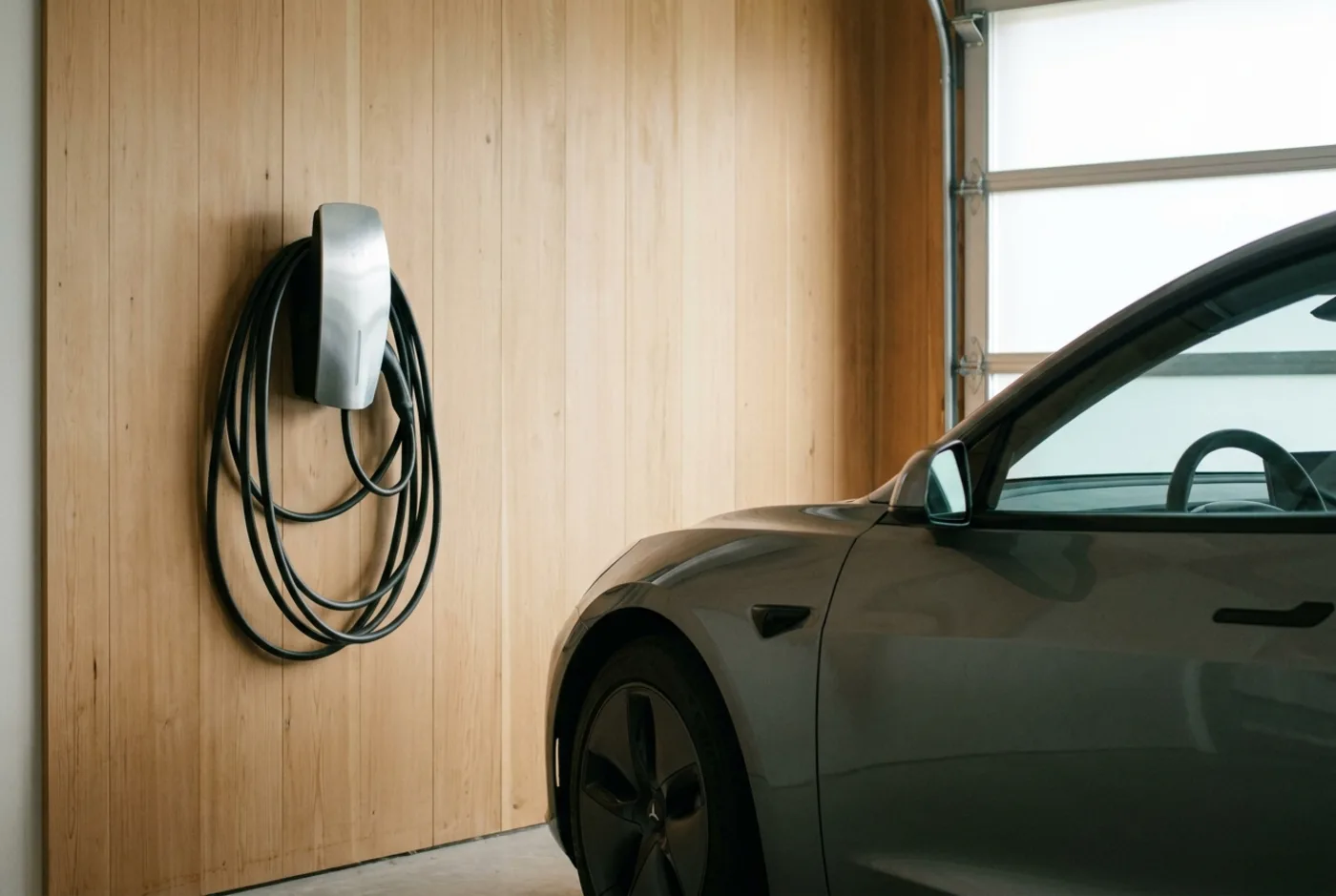
The short answer
For a Tesla-only household, the Tesla Wall Connector is usually the right choice. It is the most affordable option, it integrates with the Tesla app you already use, and it is designed for the cars.
For a mixed-EV household (a Tesla plus a Ford, Rivian, or anything else), a universal charger (such as a Wallbox or ChargePoint) is the more flexible choice, since it works with every EV.
For a non-Tesla household, a universal charger.
For a household planning to add a second EV of a different brand, a universal charger gives you the most flexibility.
Cost, in plain terms
The Tesla Wall Connector is generally the lowest-cost piece of hardware, while universal chargers run a bit more. For a Tesla-only home, that savings is real and worth taking. For a mixed-brand home, the flexibility of a universal charger is usually worth the small difference. The charger cost folds into your install quote either way.
Charging speed, which matters less than you think
For overnight charging, every Level 2 home charger adds far more range than a typical day of driving uses. Whatever you choose, plugging in overnight gives you a full charge by morning for normal commuting. The differences in charging speed between models only matter for high-mileage drivers, road-trip preparation, or fleet use.
Tesla Wall Connector strengths
- Lower hardware cost than most universal chargers.
- Tight Tesla app integration, with charge status, scheduling, and history in the app you already use.
- Designed for the cars, with the connector and software tuned for Tesla.
- Power sharing, so multiple units can share a single circuit and balance the load, useful for multi-charger setups.
Tesla Wall Connector limitations
- Tesla connector by default. A non-Tesla EV needs an adapter to use it.
- Best inside the Tesla ecosystem. It still works if you are not a Tesla household, but you do not get the full app features.
- Less universal, which matters most for a mixed-brand household over the next few years, even as the industry moves toward a shared standard.
Universal charger strengths
- Works with every EV, including Teslas with an adapter.
- Its own app ecosystem, not tied to one car brand’s software.
- Smart-home and time-of-use scheduling support on many models.
- Better for resale, since the next owner’s EV, whatever brand, can use it.
When two chargers make sense
For a household charging two or more EVs overnight, the options are:
Two separate chargers, each on its own circuit, best when both cars need a full charge every night.
One charger, taking turns, the cheapest route but requiring you to swap which car is plugged in.
A dual-port charger, a single unit with two cables that balances the load between them.
For most multi-EV households, two chargers offer the best long-term flexibility. When we install the first charger, we often run conduit for a second at the same time, so adding it later is simple.
The shift toward a shared connector standard
Tesla’s connector design has been adopted as a shared standard by most major automakers for future EVs. For home charging in 2026, the practical upshot is that chargers are becoming increasingly interchangeable with the right adapter, which lowers the risk of either choice. A Tesla charger can charge a non-Tesla EV with an adapter, and a universal charger can charge a Tesla with an adapter. The commitment either way is smaller than it used to be.